Ivory Coast: the mission in the words of those who lived it.
The start of the mission in Ivory Coast
Our arrival at the Abidjan airport on July 30, 2012, wasn’t exactly ideal. Most of the luggage that had left from Milan Malpensa hadn’t been loaded onto the plane during our layover in Tunis. So, for four days, we found ourselves managing our stay with the bare minimum: a few changes of clothes and shoes suitable for a tropical climate, with temperatures between 24 and 26 degrees and humidity close to 70%. Certainly not the best way to start a business trip.
After taking care of the administrative paperwork and waiting to retrieve our luggage, we began to get a sense of Abidjan. The city appeared congested with thousands of run-down taxis and buses, choked by smog, and chaotic beyond all expectations. Amidst a situation of urban decay and widespread poverty, daily life played out amid misery, suffering, and very precarious sanitary and hygienic conditions.
Health emergency and urban conditions in Abidjan
Unlike what was experienced during the 2009 mission, the street lighting had improved, but numerous checkpoints set up by the militia were still present, marking the route along the main arteries. The flashlights of the soldiers, checking the cars in the night, illuminated our pale and tired faces: the documents of our local companions were our only guarantee of safety.
Ivory Coast, at the time, was still scarred by ten years of instability and internal guerrilla warfare between the factions of Ouattara and Gbagbo. The country, the world's leading producer of cocoa and an important exporter of coffee and rubber, also possesses immense mineral wealth, including diamonds, gold, oil, and manganese. However, its economic potential was held back by political tensions and evident urban decay.
Visit to Grand Bassam: the colonial heritage of the Ivory Coast
While waiting for our luggage, we visited Grand Bassam, the former French colonial capital, which is now an important tourism and craft center. Despite the beauty of the place, the environmental decay was evident, with heaps of waste (especially plastic) invading the beaches.
Humanitarian aid: support for the Bongouanou hospital
Our arrival at the Bongouanou hospital was met with great warmth. The memory of the previous mission was still alive, during which hospital furnishings, defibrillators, operating room equipment had been delivered, and health training for doctors and nurses had been organized.
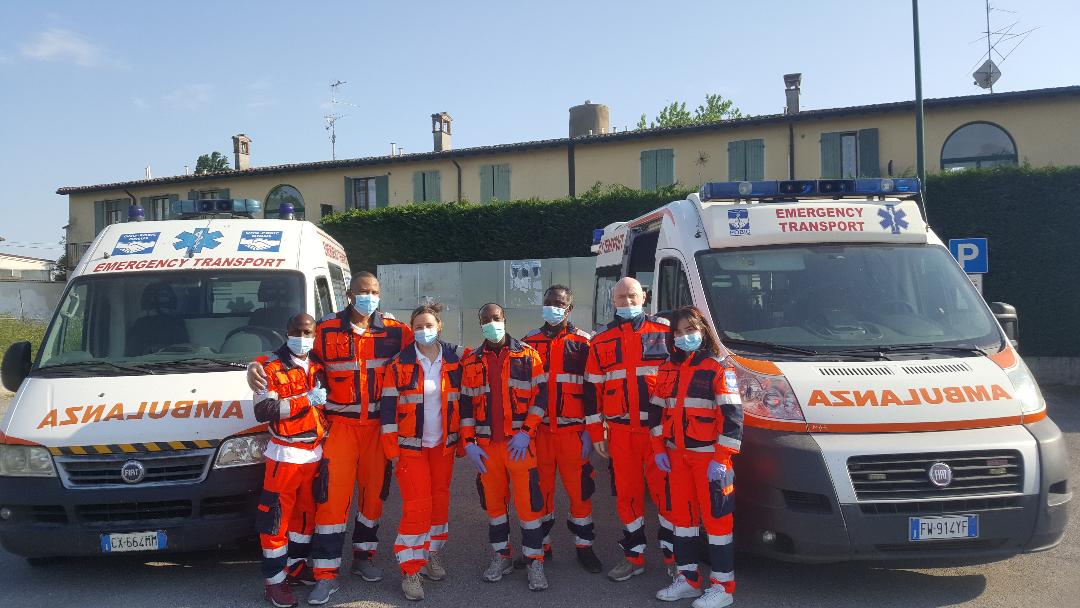
This time, our task involved improving health training, specifically regarding the management of cardiocirculatory emergencies. Furthermore, it was planned to transfer of four ambulances intended for the medical transport of patients from the villages to the local hospital and, if necessary, as far as Abidjan. The effectiveness of these donations was demonstrated immediately: during the transfer of the ambulances, a traffic accident made it necessary to immediately use one of the vehicles to transport an injured person to the hospital.
Healthcare training and local resilience
Meanwhile, cardiopulmonary resuscitation (CPR) training courses continued with the use of adult and pediatric training manikins, which were subsequently donated to the hospital to continue practical exercises independently.
During the weekends, visits to the villages and meetings with local communities were organized.
Memorable was the trip to the village of origin of our valued Ivorian collaborator Tano, nestled in the forest. Here, in a simple and genuine setting, the children, many of whom were seeing a white man for the first time, reacted first with fear and then with enthusiasm, joyfully participating in photographs and impromptu games.
Local traditions and culture of the Horn of Africa
There was no shortage of local celebrations, such as the visit to the village of Fabien, another notable of the area, where we were welcomed with traditional meals — including dishes made of porcupine and stewed agouti, forest delicacies offered with great hospitality.
The 52nd anniversary of independence: a historic moment
Finally, on August 7, 2012, we participated in the celebrations for the 52nd anniversary of Ivory Coast's independence from France. The city of Bongouanou came alive with parades, dances, colorful markets, and cultural events that involved the entire population.
Conclusion
The Emergency Transport mission represented an important action of international cooperation in the field, capable of integrating medical and logistical assistance with a deep respect for the local culture, thereby strengthening the bonds between distant peoples united by the same spirit of solidarity.
THANKS TO YOUR SUPPORT
WE SAVE THE LIVES OF DOZENS OF CHILDREN EVERY YEAR.
HELP US DO EVEN MORE.
Marketer and professor of communication and marketing, sensitive to humanitarian and relief issues. I only write about what truly interests me, and POBIC's mission is of crucial importance.